
Netia Managed EDR | Netia
Top menu

Netia Managed EDR

Netia Managed EDR is a managed IT security service that provides round-the-clock monitoring, detection and response to threats on the customer’s endpoints (computers, servers, mobile devices), utilising EDR (endpoint detection and response) technology.

Monitoring
24/7 monitoring of endpoints (computers, laptops, servers) for IT security, based on agents installed on end devices. Ability to reconstruct the entire attack path and full visibility of activity on endpoints (processes, files, memory, users, connections, operating system, system events, etc.).
Threat identification
Detection of even the most advanced attacks (e.g. zero-day, fileless malware, ransomware, lateral movement) and immediate response (automatic or manual) to IT security incidents, until the system is restored to its pre-incident state.
Regulatory compliance
Meeting the requirements of legislation, norms and standards, e.g. GDPR, UKSC [Act on the National Cybersecurity System].
Cost savings
Significant savings compared to purchasing a service or building an in-house SOC.
Come and talk to us!
or call us at
+48 22 35 81 550
3 technologies to choose from:
ESET, TREND MICRO, CORTEX.
24/7 monitoring
of selected endpoints.
Ability to respond automatically
to security incidents as they arise.
Ability to protect
any number of endpoints.
Ability to protect various resources:
servers, workstations, virtual machines, mobile devices or Docker containers.
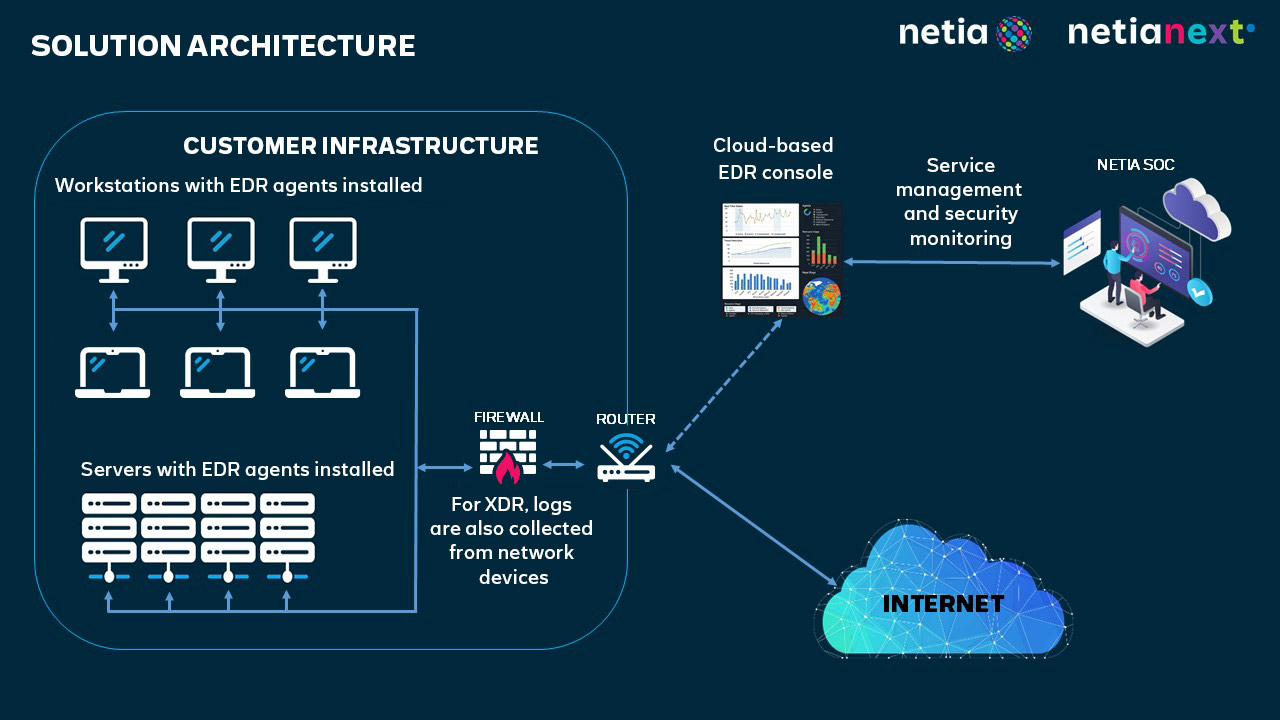
Ability to monitor network devices as well
(e.g. FW/NGFW/UTM, IDS/IPS, VPN/NAC, DNS, WAF, routers/switches).
Ability to integrate
with the customer’s SIEM systems.
Log retention:
up to 90 days.
SLA


24/7 security for your business

Netia Managed EDR monitors your company’s cybersecurity 24/7 and responds immediately to any security incidents detected.

Any questions?
Request a contact
or call us at +48 22 35 81 550

Partners


  • eset
  • trendmicro
  • cortex
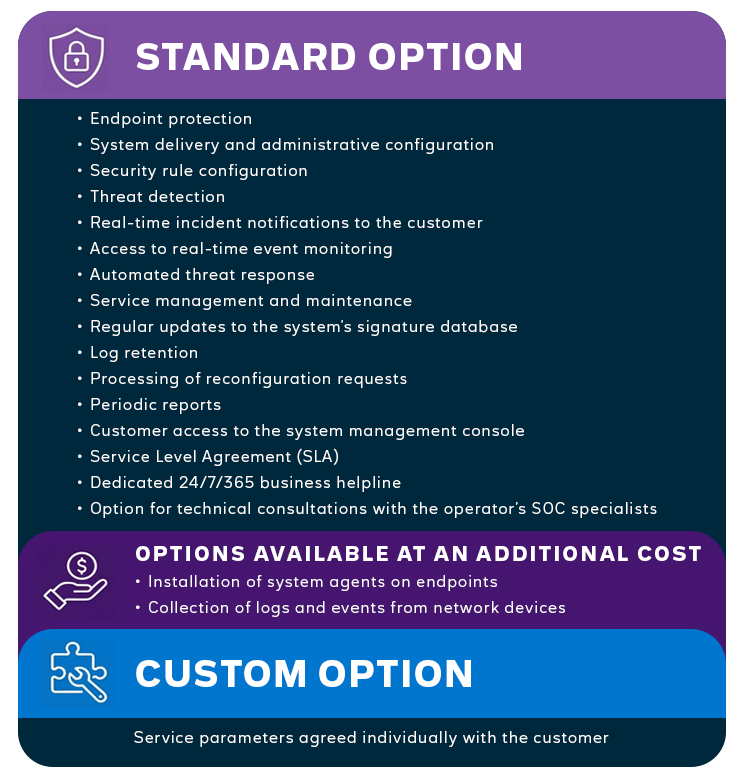
Service option table

Outsourcing-02.png

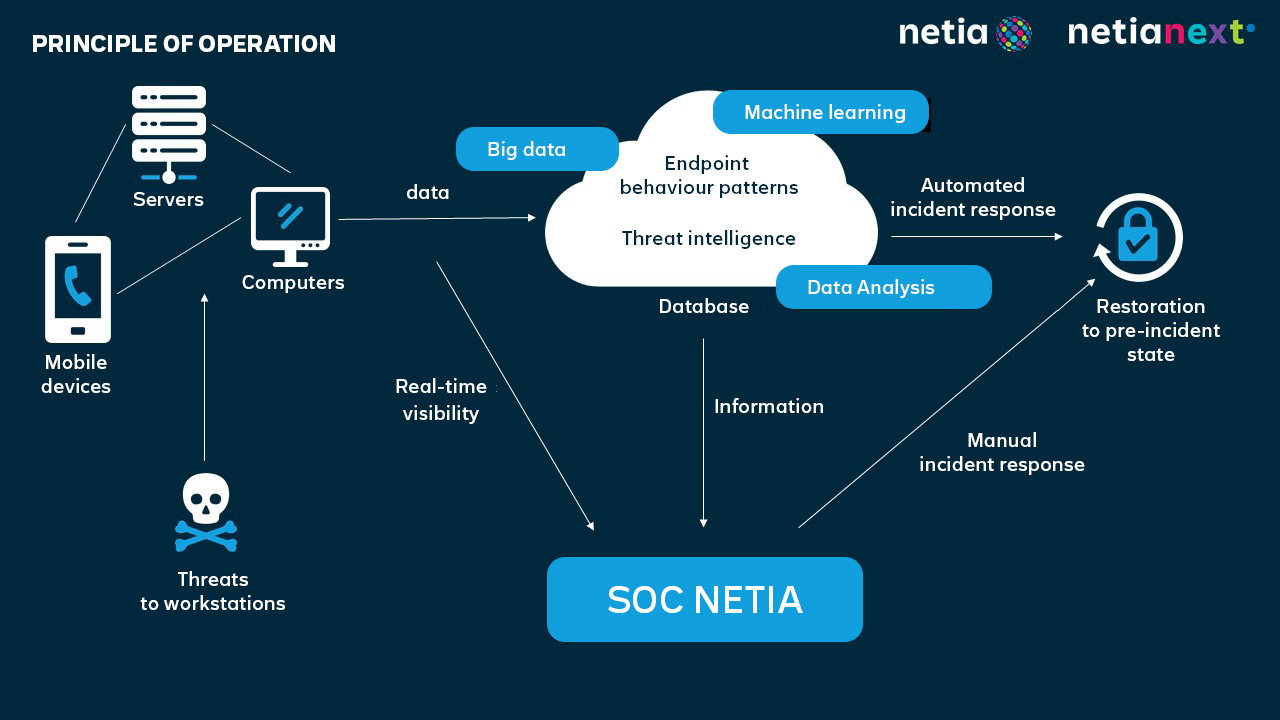
How the service works

Outsourcing-02.png

Solution architecture

Outsourcing-02.png

Come and talk to us!
or call us at
+48 22 35 81 550
FAQ

  • What is an EDR system?

    EDR, or Endpoint Detection and Response, is an advanced system for monitoring activity at the endpoint level. This service meets the needs of modern organisations that must protect their data, infrastructure and users against ever-changing threats. Rather than merely blocking known attacks, EDR analyses activity on workstations, servers and laptops, enabling a rapid response to suspicious events.

    When explaining what EDR is, it is important to emphasise that it is a comprehensive system operating on multiple levels. Its task is to detect malware, as well as to trace exactly how the threat entered the system, what actions it took and what the consequences were. This enables cybersecurity specialists to prevent similar incidents in the future.

    Traditional antivirus solutions rely on signatures and detect threats based on known patterns. EDR works differently – it analyses system behaviour, monitors processes, file access, network connections and other aspects of user activity. This enables it to detect even those threats that are completely new and have not been identified before.

    Unlike traditional AV solutions, EDR also provides a comprehensive view of the event history. The administrator can trace every stage of an attack – from the moment of initial contact, through escalation, to neutralisation. This insight is invaluable during post-breach investigations and provides essential support for incident reporting in accordance with regulatory requirements.
  • How does an EDR system work?

    To understand how EDR works, you need to look at how the system analyses data from endpoints. The software runs in the background, constantly monitoring processes, user activity and network traffic. Every activity is logged and assessed for potential threats.

    When the system detects suspicious behaviour, it immediately triggers its analysis mechanisms. Once an anomaly has been identified, it can automatically block the process, isolate the device or send an alert to the administrator. These actions are usually carried out without interrupting the user’s work. EDR does not rely solely on known patterns, but utilises behavioural analysis, data correlation and artificial intelligence.
  • If I am not a Netia customer, can I still use the Managed EDR service?

    Yes, the Managed EDR service is independent of the telecoms provider. Any entity can subscribe to it.
  • EDR vs XDR – how do they differ?

    EDR focuses exclusively on endpoints. XDR (Extended Detection and Response) extends this approach to multiple layers of the IT infrastructure, integrating data from network systems, email and the cloud. EDR allows for in-depth investigation of incidents on a specific device, whilst XDR enables tracking of the entire attack chain across different systems.
  • How does EDR differ from SIEM and SOC?

    These solutions are complementary. EDR focuses on endpoint activity and enables a rapid, automated response. SIEM + SOC collects data from the entire IT infrastructure, providing a broader context and manual handling by analysts. For smaller organisations, EDR can serve as a substitute for a SOC.
  • How do EDR solutions differ from traditional antivirus software?

    Traditional antivirus software prevents known threats using a signature database. EDR actively monitors behaviour using behavioural analysis and AI, which allows it to detect zero-day attacks and provides full visibility into events.
  • How long does it take to activate the service?

    The average activation time should not exceed 30 days; it usually takes a dozen or so days.
  • What are the requirements?

    You must install the software (EDR agents) on servers and workstations. Any previous antivirus software must be removed to avoid conflicts.
Come and talk to us!
or call us at
+48 22 35 81 550